
After watching Jordan Peele’s new thriller Nope, I, like many, was naturally teeming with confusion and questions about the movie’s message, hidden easter eggs, and symbolism of certain facets.
With Nope being such a recent release, there isn’t much report from Peele himself to give the public a peek into his personal motives and intentions about the movie. However, this leaves vast space for flexible individual interpretation and fan theories, which is what I indulge in and delight in most.
I would like to impart some of my insights about the movie’s specific elements and their larger implications, hopefully opening doorways to a more extensive breakdown of the film.
Gordy the Monkey

Gordy’s primary stage presence is his abrupt, outrageous slaughter of the cast of a TV sitcom, Gordy’s Home, triggered due to a balloon popping during filming. Gordy, like many animal actors, can be overused to achieve an entertainment standard that is appealing to the audience and, most importantly, financially rewarding. Potentially, this scene’s undertones were hinting at what slavery’s essential principles were: profiting off of and controlling a certain group whose freedom was bounded to their master’s needs. Gordy’s outrage could imply the potential outcome of the marginalized communities continuously being toyed around with and exploited for profit.
The use of monkeys, out of all animals, is clever irony on Peele’s part. Monkeys are conventionally perceived as playful, congenial creatures, which is a stereotype that is completely bashed by the blood bath on TV show set. This audience-shocker clearly conveys that a submissive, friendly animal doesn’t mean that’s all there is to them. The latent layers of aggression surfacing due to continual oppression by crew members can parallel the frustration that minority individuals are now able to express after years of being treated unequally. This is not to categorize oppressed or minority communities as violent; instead, this scene symbolizes that there is a complexity and individuality- humanness- that has been ignored by “masters” for profit, for too long. It is no doubt that retaliation will arise. The stark resemblance of this episode to slavery displays how dehumanizing individuals and testing their limits is a common tendency when profit is in the picture.
Psychology in Slavery and Socio-Political Messages
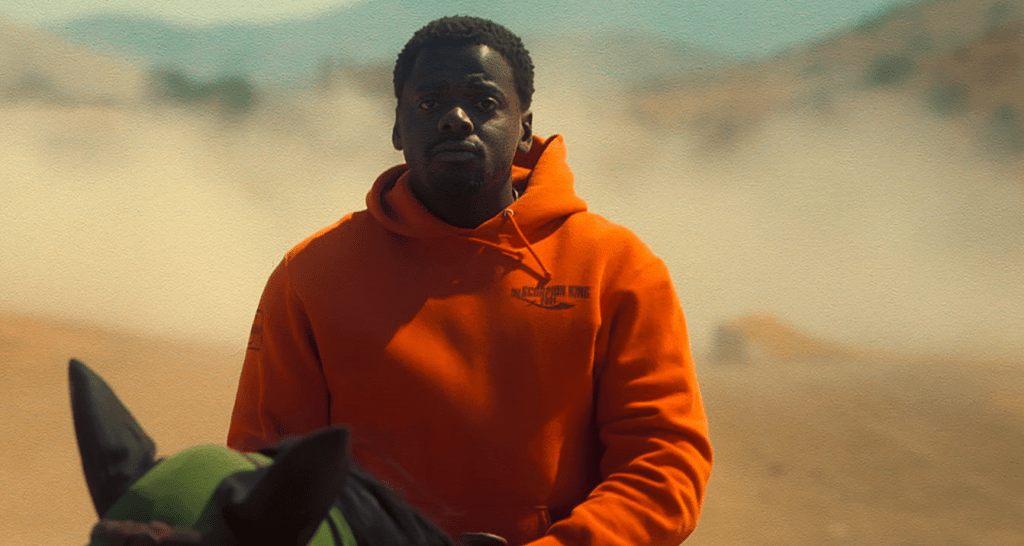
OJ, played by actor Daniel Kaluuya, is one of the main characters in the film, alongside his sister Emerald, played by actress Keke Palmer. With his lineage and experience being in horses, OJ is well-versed in the ways and the works of horse behavior. His immediate propensity when fighting off the monster UFO was to see it as a horse, which led him to save his and his sister’s life. Not looking at the UFO in the eye, and likewise, a horse in the eye, allows OJ and his peers to steer clear from being seen as a threat and prevent being eaten. This tactic, while effective in avoiding the monster from consuming them, conveys the perpetuation of slave adherence to one’s master by not meeting them at eye level. However, this concept digs deeper than simply maintaining hierarchy; in fact, looking at the oppressor makes the oppressor feel SEEN. Making the master aware of their actions threatens their ego sense of self. As a self-defense mechanism, the master attacks. The horse jumps and kicks. The master tames and tortures. Ego-level intimidation is what makes a predator subject to attack, cover-up, and inflict. It seems like there is no way out for the prey: looking the monster in the eye can be lethal, but so is being constricted as a slave. The beauty of this movie, as shown through the ending scenes, is that mortal freedom can be attained through the intricate balance of facing your fears and maintaining integrity towards one’s goals.
The power of people of color (POC) collectively standing together is shown throughout this film. For instance, when the monster UFO annihilates the fake white horse, the attached string of brightly-colored flags trickles down from the surrounding haunting cloud of the UFO, unable to be consumed by the monster. Another instance is when OJ is about to be eaten by the UFO, but with the help of the flag thread, is able to cleverly seek refuge in a shed. With the union of POC against oppressive powers, it is repeatedly proven that no force, no matter how almighty it seems, can win.
Profit- But at What Cost?

This movie shows the lengths to which characters go for some kind of achievement: monetary profit, fame, security, and peace.
For starters, OJ and Emerald’s driving force to capture footage of the UFO is to gain money in order to keep their horse stables running, as well as provide them financial freedom and stability. Their fellow helping hand, Angel, played by Brandon Perea, is aware that fame and attention are byproducts of capturing the UFO. However, these characters have motivation much deeper than simply material achievement. OJ and Emerald could be putting their lives at such immense risk for proof of the UFO that snatched their father away from them. They might want to have a tangible explanation to justify the grief and loss they are experiencing. Angel’s primary reason to capture UFO evidence is so that he can be part of helping other people and saving them from harm.
Another example is how the crew members of the TV sitcom, Gordy’s Home, were definitely well-aware of the risks that come with confining (ultimately, at the end of the day) an animal to unrealistic cinematic expectations. They definitely stretched it with Gordy, resulting in the tiniest trigger to set off the animal into a killing frenzy. However, this was not at the forefront of the crew because their priorities were somewhere else: they wanted to extract the best out of the monkey for views, public admiration, money, and fame. Their materialistic incentives blinded them from potential danger and resulted in a harsh outcome. This horrific incident not only left stains of blood everywhere but also heavy trauma on a crew member, who also ends up being an important character in the film.
Ricky “Jupe” Parker, played by Steven Yeun, was part of Gordy’s Home when he was a child as well as a surviving member of the Gordy incident. He grew up to be the creator of and actor in a weirdly southwestern-alien-based carnival called “Jupiter’s Claim”. In his childhood, he witnessed firsthand the traumatizing consequences of exploiting a situation. This life lesson didn’t seem to stick with him as he proudly employed his sightings of the UFO to gain profit, glory, and attention in his ‘Star Lasso Experience”. For the sake of having something marvelous to see, he risked his life, along with many others’. Parker used the horses he bought from OJ to feed the UFO so his audience, regardless of the low attendance, would be amused. However, his persistent exploitation of the UFO for his personal gain eventually cost him his life as he was eaten up by it.
These examples can highlight how human behavior works. It seems like the mind can trick us into doing the most perilous, questionable deeds for things that society, as deemed, make one “successful” or “accomplished”. This can allow us to become more aware of our driving factors and actions, hopefully provoking us to make safer, better decisions for the greater good.

This bone-chilling film, just like every other Jordan Peele creation, carries heavy messages that transcend the basic plot and visuals. Taking the time to see what parts of the movie stand out can allow one develop a deeper appreciation of cinema. Through this, one can draw elaborate connections between aspects of the film to global issues to socio-political concepts, and beyond.
I would love to hear your theories and interpretations of the movie in the comment section below, as well as your thoughts on my thoughts!
 J I V A W A Y S
You mention in your analysis that, “Making the master aware of their actions threatens their ego sense of self. As a self-defense mechanism, the master attacks.” However, in both of the examples that you mention, the aggressor is not the master but rather the exploited. Both the horse and Jean Jacket were exploited in their own unique manner. The horse was used essentially as a movie prop, while Jean Jacket was used for the profit of Jupe’s “Jupiter’s Claim” and also in terms of providing irrefutable evidence of extraterrestrial life. In this sense, both the horse and Jean Jacket are more analogous to the “slave”. A third parallel would be the scene where Gordy did not attack Jupe upon noticing him hiding under the table. This was due to Jupe not gazing upon Gordy directly; rather, his field of vision was obscured by the table cloth. In these three instances, the “slave” rises up against their “master”. In this interpretation, I would take the direct gaze of the “master” upon their “slave” to demonstrate a measure of disrespect and irreverence: the “master” does not care about the rudeness of staring at their “slave”. Therefore, the gaze of the “master” represents the final straw after which point the “slave” can endure no more. This leads to the sudden outburst of violence which is made to seem unprovoked and irrational. However, as we know, this is not the case. When the history of oppression and maltreatment is taken into consideration, suddenly this savage display no longer seems quite as unjustifiable.
LikeLike